

Sadly, you don’t have to look too hard to find that the statistics for families of children with additional needs breaking up are catastrophically high. Psychology Today reports that “… the rate of divorce in families with a child with disabilities may be as high as 87%. The divorce rate in families with a child with autism is about 80%”. While these alarming figures are at the top end of those published, the general consensus seems to be that the rates are considerably higher, perhaps twice as high, for families of children with additional needs, than for the rest of the population which hovers around 40-42% (itself still alarmingly high).
The internet is awash with legal firms offering advice and services for parents of children with additional needs wanting to leave their family behind. It’s heartbreaking to see.

The pressures of parenting a child (of any age) with additional needs are very real, and can and do bring parents to the brink. A significant decrease in the secular support offered to families in the last few years, largely as a result of covid and then a massive decrease in funding available to local authorities, has meant that families have often been left to cope on their own without much, if any, help. Many have found it all too much.
So, is there hope, some light in the darkness? And is there a role for the church in filling some of the gaps that have been left as secular services have reduced or stopped? I believe the answers to both of these questions can be “Yes”.
A family I know found themselves at the beginning of the long summer holidays with no secular respite provision available to help them with their two children, both of whom have various additional needs and health conditions and need constant care and supervision. In desperation, they reached out to their church and asked if there was anything that the church could do to help… and their church stepped up magnificently. Here are just some of the things the church did.
- Food – They started by doing what all good churches do in a crisis, they baked! Lots of food was prepared and brought round to the family so that they didn’t have to think about preparing meals all the time.
- Childminding – They formed a little team that sent a couple of people to the family at least once a week to look after the children while the parents were able to go out for a walk, or to get a coffee, or to watch a movie together.
- Longer respite – This same team also occasionally took the children out to a theme park for the day, giving the parents a whole day to plan an adventure out together… or just to sleep… whatever they preferred.
- Home group – There was support given to the parents so that they could come to home group and be spiritually nourished, as well as socialising with their church family, knowing that the children were being well cared for at home.
- DIY SOS – The pressures of caring for the children, work, all the daily household chores, etc. had meant that the house and garden had been left a bit uncared for. The church arranged a ‘DIY SOS’ day, coinciding with the children going to a theme park and the parents having a day out, during which they decorated the house, sorted out a few outstanding DIY jobs, tidied up the garden, etc.
- Pastoral care – The pastoral care team from the church was available to chat with the family, to listen to them, to offer counselling, to see what else the church could do to help.
- Valued – What all of this did was to show the family that they were not forgotten, that they are loved and valued, that their church family cares about them and wants to serve them. It made a huge difference to this family over that otherwise challenging school holiday period, and beyond.
This is just one example of churches stepping up to meet the needs of additional needs families when they needed it most. Maybe other churches could follow this lead? Maybe churches could see the need and respond in love to bless families that might otherwise massively struggle.
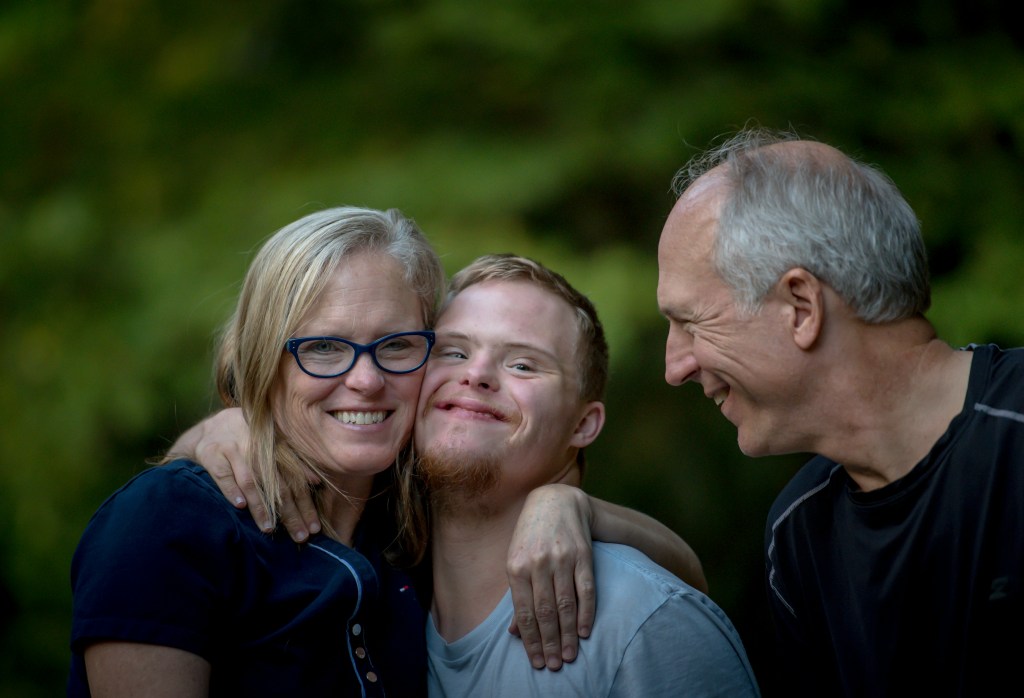
Maybe, in doing so, churches could play a part in reversing some of these catastrophic figures relating to families with additional needs splitting up. Couples split up for all kinds of reasons, but let it not be because they didn’t get any help and support from their church when they were feeling overwhelmed and desperate, when they needed their church family to step up and help them the most. What can your church do?
Peace,
Mark
All text © Mark Arnold / The Additional Needs Blogfather
Image credits:
Heart on a line: Photo by Kelly Sikkema on Unsplas
Rings: Photo by Zoriana Stakhniv on Unsplash
Family: Photo by Nathan Anderson on Unsplash

 The Additional Needs Blogfather
A really helpful blog about how churches can help. I also remember hearing Donna Jennings talk about the low-key evangelistic opportunities that arise when churches give support to families who are not church members, eg providing a space for a special get-together for families with children with additional needs.
LikeLiked by 1 person
Dear Mark,
I trust that your family and yourself are keeping well by The LORD’S Grace 🙏🏼
I wanted to say thank you for this very interesting article. It made me glad to read that the Church still cares for people who are suffering. I guess it brought me hope this morning.
I still have no answer from the director of Autism Mauritius. I have recently sent her a reminder but I shall do so again. I trust that The LORD has a Perfect Plan.
You are in my prayers. Talk soon with good news hopefully!
Blessings,
Amaëlle.
LikeLiked by 1 person